February 23rd2027

Technological Sovereignty & Autonomy Summit – Third Edition

Institut de France

23 Quai de Conti, 75006, Paris


How can we strengthen our technological resilience and strategic autonomy?

Following two editions at Bercy and a Manifesto setting out 33 proposals, IMA invites public and private sector decision-makers to the Institut de France on 23 February 2027. IMA invites you to discuss the strategic and operational choices that shape our digital autonomy and determine its future. How can we identify our dependencies? Which should we reduce first? Beyond statements of intent, the Summit offers practical insights from our organisations' projects to regain autonomy and resilience. You will also discover French and European technology champions through what their solutions are already delivering in production.

The plenary discussions will focus on governance, procurement and investment choices. Across three rooms, user organisations and technology teams will share demonstrations and case studies, from selecting a solution to deploying it in production, including costs, results and limitations.

Discover French and European technology champions through demonstrations and practical case studies: cloud, computing and infrastructure; data, architectures and software; AI models; agentic AI and development; cybersecurity, digital identity and resilience; robotics, drones and physical AI.
THE GLOBAL CONTEXT
Must we accept our technological dependencies as inevitable?

As part of our continued, longstanding commitment to the technological and economic development of France and Europe, we are pleased to invite you to an exceptional event: the third edition of the annual Summit on Technological Sovereignty and Strategic Digital Autonomy. 

Turning a blind eye to digital dependencies is no longer tenable. In a world where digital technology determines business resilience, economic competitiveness and national sovereignty, France and Europe are falling behind and face significant technological dependence.  The rivalry between the United States and China for technological supremacy has consequences far beyond their borders. An export restriction can deprive a factory of an essential component. If a cloud provider changes its prices or access conditions, a hospital could have to revise its IT budget, or even lose access to sensitive data. In the future, a company or factory could lose control of its own production if an AI or robotics provider chose to make that happen.
Digital technology has become essential infrastructure for our economies and societies. Cloud, artificial intelligence, data, software, robots and semiconductors underpin the operations of our businesses, public services and industries.  Against a backdrop of geopolitical tensions and intensifying global technological competition, control over these technologies directly affects our competitiveness, security and freedom to make decisions. Technological autonomy is no longer a matter for future scenario planning: it is now a strategic imperative

Europe's technological dependence is a major economic challenge. According to an estimate published by consultancy Asterès in 2025, 83% of European spending on business software and cloud services went to US companies in 2024, representing approximately €330 billion out of an estimated €400 billion market. This raises questions about our ability to retain negotiating power, fund our own ecosystem and control our technological direction and our future independence in decision-making.

Today, more than 80% of the key digital technologies used in the European Union (components, software, cloud platforms and cybersecurity) are imported, particularly from the United States and China. 
Beyond technological dependence, France remains a marginal player in the global digital infrastructure market: it accounts for just 2.4% of a market worth more than €5,000 billion, according to Institut Montaigne. This imbalance undermines the country's strategic autonomy: without sovereign cloud or local production of critical components, there can be neither economic independence nor digital security. 
There is also a physical vulnerability: for example, 99% of international digital traffic travels through subsea cables. Although invisible, this infrastructure represents strategic geopolitical assets. Protecting and securing it has become a major sovereignty issue. 

The rapid development of artificial intelligence makes these choices even more important. The Eurostat report published in 2026 indicates that 55% of large companies in the European Union used AI technologies in 2025, compared with 41.2% in 2024. As these uses expand, decisions about models, data, computing capacity and infrastructure are becoming fundamental to organisational autonomy.

Recent developments in Europe reflect a growing commitment to action. On 3 June 2026, the European Commission presented a package on technological sovereignty, including the proposed Chips Act 2.0, Cloud and AI Development Act and a European open-source strategy. More recently, on 4 November 2026, the launch of the European chip design platform EuroCDP marked another milestone: the Commission and Member States are mobilising around €500 million in public investment to support this initiative.

Public procurement is also becoming a practical driver of adoption. In April 2026, the European Commission awarded four contracts enabling EU institutions and bodies to purchase up to €180 million in sovereign cloud services over six years, based on measurable sovereignty and resilience criteria.

These developments raise immediate questions for decision-makers: which dependencies should be reduced first? Which French and European alternatives meet operational requirements? How can they be successfully integrated and scaled?

The third edition of the Summit builds on this momentum: showcasing solutions, sharing successful deployments and giving organisations the means to act.


From declared autonomy to autonomy in practice

One ambition guides this edition: to see what works, understand how it was achieved and be able to replicate it.

The programme combines strategic addresses, technology demonstrations and case studies from major user organisations.

Users will be at the heart of the discussions, alongside the relevant French and European providers. They will share the context of their projects, their decision criteria, the difficulties encountered, the results achieved and lessons useful to their peers: integration, migration, security, performance, costs and the conditions required to scale.

The aim is to provide decision-makers with practical evidence to inform their investments and transformation plans.


The strategic plenary: technology governance and dependency management

The morning will open with technology governance and dependency management. Which activities require continued control over data, software and its operation?

We will also explore the role of public and private procurement, funding and European cooperation. For a technology company seeking to grow, moving from a first contract to deployment across several major customers is an industrial scaling challenge. For the buyer, the supplier's long-term viability is at stake.

The plenary will examine the challenges faced by user organisations alongside the capabilities of the technology ecosystem and the opportunities for collective action.


Three thematic tracks covering the entire technology chain


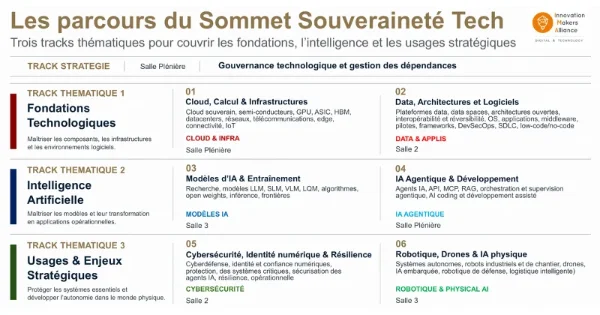
Demonstrations and case studies: from components and infrastructure to AI models, software and critical applications, six major sessions will explore French and European capabilities.


Track 1 — Technology Foundations

Maintaining control over components, infrastructure and software environments.

  • Cloud, Computing & Infrastructure: sovereign cloud, semiconductors, GPUs, ASICs, HBM, data centres, networks, telecommunications, edge computing, connectivity and IoT.

  • Data, Architectures and Software: data platforms, data spaces, open architectures, interoperability, reversibility, operating systems, applications, middleware, frameworks, DevSecOps, the software development lifecycle and low-code/no-code.


Track 2 — Artificial Intelligence

Maintaining control over models and turning them into operational applications.

  • AI Models & Training: research, LLM, SLM, VLM and LQM models, algorithms, open weights, training, inference and frontier models.

  • Agentic AI & Development: AI agents, APIs, MCP, RAG, agent orchestration and oversight, AI coding and assisted development.


Track 3 — Applications & Strategic Challenges

Protecting essential systems and building autonomy in the physical world.

  • Cybersecurity, Digital Identity & Resilience: cyber defence, digital identity and trust, protection of critical systems, AI agent security and operational resilience.

  • Robotics, Drones & Physical AI: autonomous systems, industrial and construction robots, drones, embedded AI, defence robotics and intelligent logistics.


A shared requirement: examining sovereignty from end to end

Control over a solution must be assessed across its entire technology chain. Discussions will address the origin and control of technologies, their hardware and software dependencies, control over data, reversibility and the ability to maintain operations if a supplier relationship ends.

The challenge is to make dependencies visible and assess the real freedom of action available to organisations.

Measuring digital resilience will also be highlighted, particularly through the Digital Resilience Index (IRN), a Digital New Deal initiative designed to help companies measure and manage their resilience to geopolitical, technical and economic risks.


An event for decision-making, deployment and cooperation

The Summit is aimed at executives and decision-makers from large companies, mid-sized businesses, public administrations and local authorities: senior management, CIOs, CTOs, heads of AI and data, CISOs, and leaders in innovation, transformation, procurement and business functions.

Peer discussions and meetings with representatives from technology, public institutions, research and investment will help participants identify partners and explore new opportunities for cooperation.

This third edition continues the momentum that began in 2025 and led to the Manifesto for Technological Sovereignty and Strategic Digital Autonomy in France and Europe and its 33 proposals.

Join us on 23 February 2027 at the Institut de France to discover solutions, share experiences and prepare your next technology decisions.


An ambitious summit to drive lasting change

Provisional schedule · Tuesday 23 February 2027

TimeProgramme
08:30–09:00Welcome and breakfast in the Grande Halle
09:00–10:50Opening, followed by the strategic plenary on technology governance and dependency management
10:50
–11:30
Break and networking
11:30
–12:50
Three parallel sessions · Plenary — Agentic AI & development · Room 2 — Cybersecurity, digital identity & resilience · Room 3 — Robotics, drones & physical AI
12:50
–14:00
Lunch and networking in the Grande Halle
14:00
–15:20
Three parallel sessions · Plenary — Cloud, computing & infrastructure · Room 2 — Data, architectures and software · Room 3 — AI models & training
15:20
–16:00
Break and networking
16:00
–17:30
Additional presentations and case studies — programme in preparation
17:30
–18:30
Closing plenary, followed by a drinks reception in the Grande Halle

This third edition will bring together leading public sector decision-makers, executives from major companies, strategic technology players and European ecosystems committed to building sustainable, interoperable and competitive digital autonomy. 

We will introduce you to outstanding French and European digital and technology start-ups and companies distinguished by their innovations and technological sovereignty.

Networking Sessions and Meetings: 
Do not miss the opportunity to meet your peers, potential partners, market experts, investors and policymakers to discuss possible collaborations! 

We invite you to join us for this unique event and discover how major companies and French innovators are shaping the future of France's strategic autonomy. Together, let us help build a future in which technology serves national sovereignty and independence.

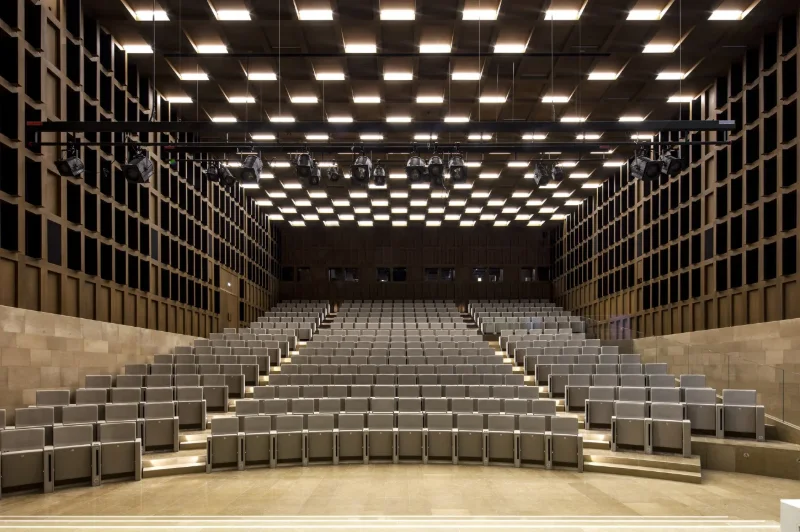
The Institut de France auditorium will host the plenary on 23 February

Institut de France: an iconic venue

The Institut de France brings together five academies where scientists, writers and artists meet. We chose this “parliament of the learned world” to bring researchers, industry leaders and public sector decision-makers together to debate the technologies that France and Europe want to continue designing and producing.

Focus on an essential initiative 

The Digital Resilience Index

We have also chosen to highlight an initiative from Digital New Deal, the think tank chaired by Olivier Sichel (Chairman of Caisse des Dépôts et Consignations):
IRN, the Digital Resilience Index 

Digital New Deal launched the Digital Resilience Index (IRN) in July 2025, alongside former minister Clara Chappaz, Olivier Sichel (Caisse des Dépôts) and several senior business leaders, with support from Medef. 

This industry-wide framework, developed by and for businesses, provides a common, transparent and robust basis for measuring, comparing and managing digital resilience in the face of geopolitical, technical and economic threats. 

Based on objective criteria (share of software purchases, data location, use of open technologies, risk culture, etc.), the IRN is designed as a practical tool to support technological autonomy. 

We will present an initial assessment of the IRN's implementation and of our organisations' level of resilience.

Building collective momentum since 2025

The inaugural edition, held on 14 January 2025 at Bercy, brought together more than 600 public and private sector leaders: CIOs, CTOs, CDOs, Chief AI Officers, industry executives and sovereign technology providers, alongside public authorities, political leaders and representatives of the investment community.

More than 50 strategically important French companies and start-ups took the stage to present their trusted solutions and their visions for Europe’s digital future.

This success helped build lasting national momentum, culminating in the publication, in May 2025, of our “Manifesto for Technological Sovereignty and Strategic Digital Autonomy in France and Europe”.

The Manifesto, which involved several hundred organisations and institutions:
- Set out 33 concrete measures to accelerate efforts to regain technological control;
- Provided a shared strategic framework for Europe, the French state, businesses, public administrations and the technology ecosystem;
- Generated significant national media coverage and influenced discussions with European institutions;
- Shaped a collective roadmap to strengthen French and European strategic autonomy.

Key figures from the 2026 edition

1100

Registered attendees

50

Innovative organisations attending

70+

Speakers

List  of Sovereign Technology Providers